Made in USA cryptocurrencies fall as the crypto love affair with Trump family moves close to divorce
Crypto backed Donald Trump for a reason. He gave the industry a simple political promise: less enforcement, friendlier rules, and a White House that would treat Bitcoin and digital assets as part of the American growth story instead of a threat to be contained.
That bargain helped Trump build real support inside crypto during the 2024 election cycle. It also helped bring a new type of voter into the coalition, people who saw crypto policy as part of a wider fight over innovation, markets, and state power.
The problem now is that the same community that once treated Trump as an asset is increasingly treating the Trump-branded crypto complex as a liability.
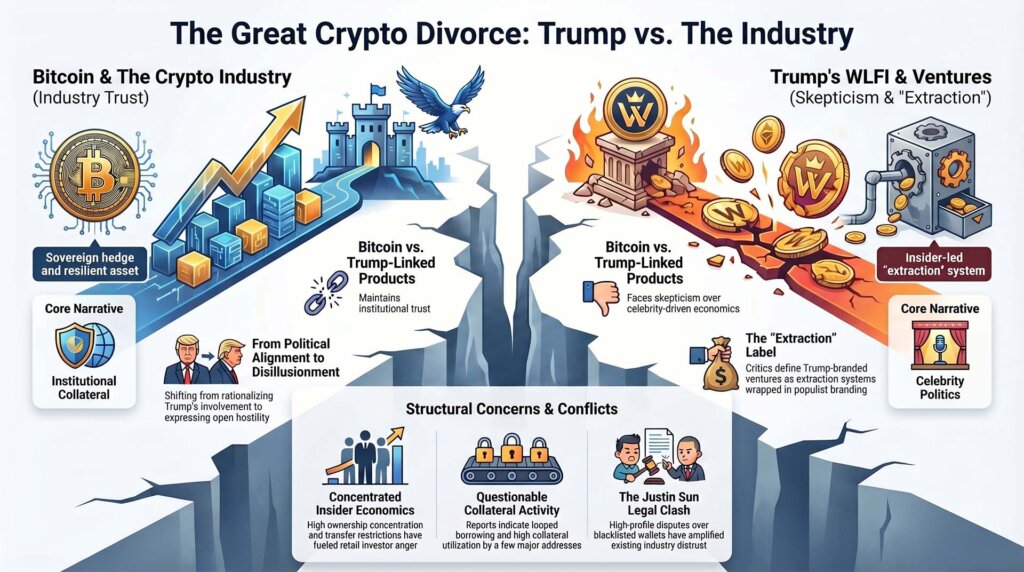
The great crypto divorce: Extraction, betrayal, and Trump’s token crisis
The shift has been building for months, then accelerated as WLFI slid toward its lows, as the economics of the Trump family’s token ecosystem came under sharper scrutiny, and as crypto-native reaction across X moved from rationalization to disgust.
The temperature change is hard to miss. After the 2024 election, pro-Trump sentiment on crypto timelines carried a triumphal tone.
Over the past several days, the language has turned prosecutorial. Traders, founders, and long-time market voices are now describing the Trump family’s crypto ventures as extraction, grift, and a stain on the industry’s legitimacy.
That shift has a market side and a political side. On the market side, Bitcoin has held up far better than the family’s branded ecosystem. Bitcoin remains the asset that institutions, public companies, and macro traders can still frame as scarce collateral, a sovereign hedge, or a reserve candidate.
WLFI sits in a very different bucket, a governance token wrapped in celebrity politics, concentrated economics, supply overhang, and widening distrust.
On the political side, the danger for Trump is broader. He used the crypto vote in 2024. If the industry starts to view Trump-linked tokens as a case study in how political power can be converted into private crypto wealth, the same constituency that helped him may become a source of blowback heading into the midterms.
The language inside crypto has changed from coalition politics to retail betrayal
The strongest evidence for a real break comes from the shift in language inside crypto itself. Participants tend to defend their own until losses can no longer be rationalized. Sharp practice, misaligned incentives, and personality-driven ecosystems persist longer than outsiders expect.
When that tolerance gives way, the tone flips quickly. The Trump conversation has reached that point.
“The president of the united states is the biggest crypto grifter in history. and he’s done it in broad daylight.”
“Trump never cared about Crypto. It’s time to admit that all of us were duped.”
It is politicians themselves who are the antithesis of crypto.
These reactions carry weight because they are not coming from Elizabeth Warren’s office or from anti-crypto academics. They are coming from market participants, founders, and long-time industry voices who, in another context, might have been expected to defend a pro-crypto president or at least keep the focus on policy gains.
The emotional center of this moment is retail betrayal. The charge running through community reaction is simple. Trump sold the cultural authority of his name and the political authority of his office into crypto products that looked open, populist, and aligned with decentralization, while the underlying economics favored insiders, controlled access, and family-linked revenue extraction.
CryptoSlate previously reported that Trump’s crypto empire had become the center of a new influence economy, and separately that WLFI was selling $5 million “Super Node” access while pitching finance for everyone. Those two threads now converge into a public perception problem that is larger than one token.
Price action sharpened that perception. The family’s branding machine once seemed capable of lifting anything it touched. That aura has faded. WLFI is far below its September peak and trading close to its April low.
Meanwhile, Bitcoin has remained comparatively resilient. That divergence gives the backlash a clearer shape. The community has separated Bitcoin from Trump. It now also has to decide whether to separate pro-crypto policy from Trump-branded crypto products.
Those two separations are politically dangerous because they break the old package deal. Support for Bitcoin can survive while support for Trump’s crypto ventures collapses.
Several posts captured that rupture with unusual force. One widely shared line from TXMC said, “You know it’s bad when one of the biggest scammers of all time [in reference to Justin Sun] denounces the president’s business for being even bigger scammers.”
A post from Drew Austin called WLFI “quite possibly the worst and most blatant fraud” he had seen in 13 years in crypto. Hyperbole is common on X, though the direction of travel here is the point. These are not isolated sneers from outside the room. This is the room turning on the host.
Concentrated economics and control became harder to ignore as WLFI lost altitude
The market can reprice trust without a smoking gun. A structure that feels stacked, a chart that confirms it, and a series of disclosures or allegations can be enough to make participants ask whether they ever understood the deal in the first place. WLFI now checks several of those boxes at once.
The token launched into public trading with a multibillion-dollar headline valuation, with CryptoSlate reporting a $7.4 billion valuation on day one. Public excitement looked strong. The structural questions never went away.
CryptoSlate also noted that holders voted overwhelmingly to back public trading, and tracked rising anticipation even before transfer restrictions were lifted. That helped produce the launch frenzy. It also created the conditions for a harsher reset once public price discovery met concentrated ownership, thin effective liquidity, and mounting distrust over how the system actually works.
The Trump family’s economics are a major part of that reset. WLFI closed a raise above its target and has become a serious capital machine, with a much larger influence on the economy around the project.
Outside crypto media, Forbes estimated Trump’s net worth at $6.5 billion in March 2026, up $1.4 billion from the prior year, while Reuters, reporting widely across secondary coverage, put the Trump family’s crypto income above $800 million in the first half of 2025 alone.
Those figures establish scale. Once the scale becomes visible, the community starts asking how the value moved, who captured it, and whether the public side of the trade ever had a fair shot.
That is where the retail anger deepens. A post from Wealthy Anon framed WLFI as “a one-way door with a MAGA flag on it.” The complaint is that Trump-linked branding created social trust while token structure, liquidity conditions, governance control, and insider economics concentrated the payoff elsewhere.
Another post from gum claimed that among 4,898 verified WLFI-holding wallets on Solana with identifiable PnL data, 4,719 were at a loss and 74 were in profit.
The market is primed to believe a retail pain narrative because the broader structure already feels predatory to many participants.
Recent scrutiny of collateral use and leverage pushed that perception further. A breakdown from Chaos Labs described a looped-borrowing structure tied to WLFI exposure on Dolomite, with two primary addresses accounting for most of the activity, and WLFI collateral utilization pushed close to its cap.
Thus, a token associated with the president’s family has become intertwined with concentrated borrowing behavior, synthetic support mechanics, and an evolving debate about how much of the visible market reflects organic demand versus internal recycling. That has consequences for sentiment even before a regulator, court, or auditor reaches a conclusion.
A clash with Justin Sun has now fed the fire. Sun’s public allegation that WLFI embedded a blacklist function and froze his wallet gave the controversy a high-drama focal point, while WLFI replied that it had the contracts, the evidence, and the truth, and would see him in court.
Sun then fired back, asking, as the largest WLFI investor, for the person behind the WLFI social media account to reveal themselves.
The deeper issue is that the community’s trust is breaking because the Trump family’s crypto products are increasingly viewed as an extraction system wrapped in populist branding. Sun became a catalyst. He did not create the sentiment.
The midterm risk is becoming easier to see as the crypto vote turns from asset to vulnerability
Trump gained a real advantage from being the candidate who spoke crypto’s language in 2024. He understood that Bitcoin voters, builders, and donors wanted a president who would stop treating the industry as a permanent suspect class.
That support was instrumental, especially among people who viewed crypto as part of a wider argument about economic freedom, digital property rights, and America’s willingness to compete in frontier technology. The danger now is that Trump’s personal monetization of crypto may damage the same political channel that helped him.
That risk already showed up in policy coverage. CryptoSlate reported in 2025 that concerns about Trump’s conflict of interest were slowing broader progress on crypto policy.
Cardano’s Charles Hoskinson has also argued that the TRUMP token cost crypto a much stronger Senate outcome and triggered a broader credibility crisis around the industry’s political agenda.
Whether one accepts Hoskinson’s framing in full, the direction of pressure is clear. Every Trump-linked token controversy gives opponents a simpler attack line; crypto policy became a channel for presidential self-enrichment.
The potential midterm impact follows directly from that pressure. On Polymarket, Democrats are priced at 56% to take the Senate and 86% to take the House. Prediction markets are not destiny, and they can move quickly, though those odds capture the market’s live political instinct.
If Democrats gain one chamber, Trump faces heavier investigative pressure. If they gain both, the pressure escalates into a full-spectrum oversight environment, with subpoenas, hearings, document fights, and a much more aggressive public inquiry into the financial intersection of presidential power and family crypto ventures.
The constitutional mechanics still matter. House control could bring impeachment risk. Senate removal would still require a two-thirds vote, a much higher bar. Even without removal, a hostile Congress could turn the Trump crypto complex into a permanent scandal machine during the run-up to 2028.
The backlash now reaches beyond a reputational problem inside crypto. It is becoming a live electoral vulnerability. The same people who once saw Trump as crypto’s defender may now see him as the figure who turned their industry into a public punchline. Retail holders nursing losses are not a huge voting bloc on their own.
Cultural betrayal extends beyond wallet-level pain, especially when it ties into a broader accusation that power was used to privatize upside while distributing downside to loyalists and latecomers.
The market side remains fluid. CryptoSlate wrote in February that the post-election crypto rally had already completed an 18-month round trip, adding roughly $2 trillion in value and then erasing a similar amount.
From market snapshots, that separation is showing up across the broader “Made in USA” basket as well. Trump spent the past year promoting American-made crypto as a strategic category, though the current leaderboard shows that most of the biggest U.S.-linked names are trailing Bitcoin on every meaningful medium-term window.
Top Made in USA Crypto Assets by Market Cap
Bitcoin is down 23.18% over 90 days in the ranking view, while XRP is down 35.67%, Solana is down 42.06%, Dogecoin is down 34.71%, Chainlink is down 33.96%, and Avalanche is down 34.17%. Even on the 30-day view, Bitcoin is slightly positive while most of the flagship U.S.-associated cohort remains negative.
That weakens one of the political selling points Trump leaned on most heavily, that backing American crypto projects would translate into stronger market leadership. Right now, the market is saying the opposite.
Bitcoin has held up better, and much of the “Made in USA” complex has looked more like a lagging trade than a national-champion theme.
That created the first crack in the idea that Trump automatically equals bullish crypto. WLFI and the wider Trump token complex widened the crack into something more serious. Bitcoin can still retain support as a macro asset, reserve candidate, and institutional collateral.
Trump-linked tokens can continue to erode trust at the same time. That split is the next test. If it deepens, Trump will discover that the crypto vote he used in 2024 now carries a reverse charge. Support built on policy can disappear when the community decides the family business got there first.
The post Made in USA cryptocurrencies fall as the crypto love affair with Trump family moves close to divorce appeared first on CryptoSlate.